What changes when an SVG prompt specifies fewer details?
By Ashesh Dhakal
ai svg generatorsvg generatorsvg creatorsvg icon generatorai svg icon generatorai svg logo generatorsvg prompt
Six exports, one subject, one afternoon. The shortest prompt produced a 13-path file in one run and a 29-path file in the next. The longest prompt produced nine paths and then ten. Nothing about that is proportional to how much the prompt specified.
One instruction did behave predictably. When the prompt named a colour, the exported file used one fill value. When it did not, the same subject came back with eight and then twelve.
That is the whole finding, and it is worth stating plainly because the intuitive answer — "more detail, more control" — is not what the files show.
What was held constant
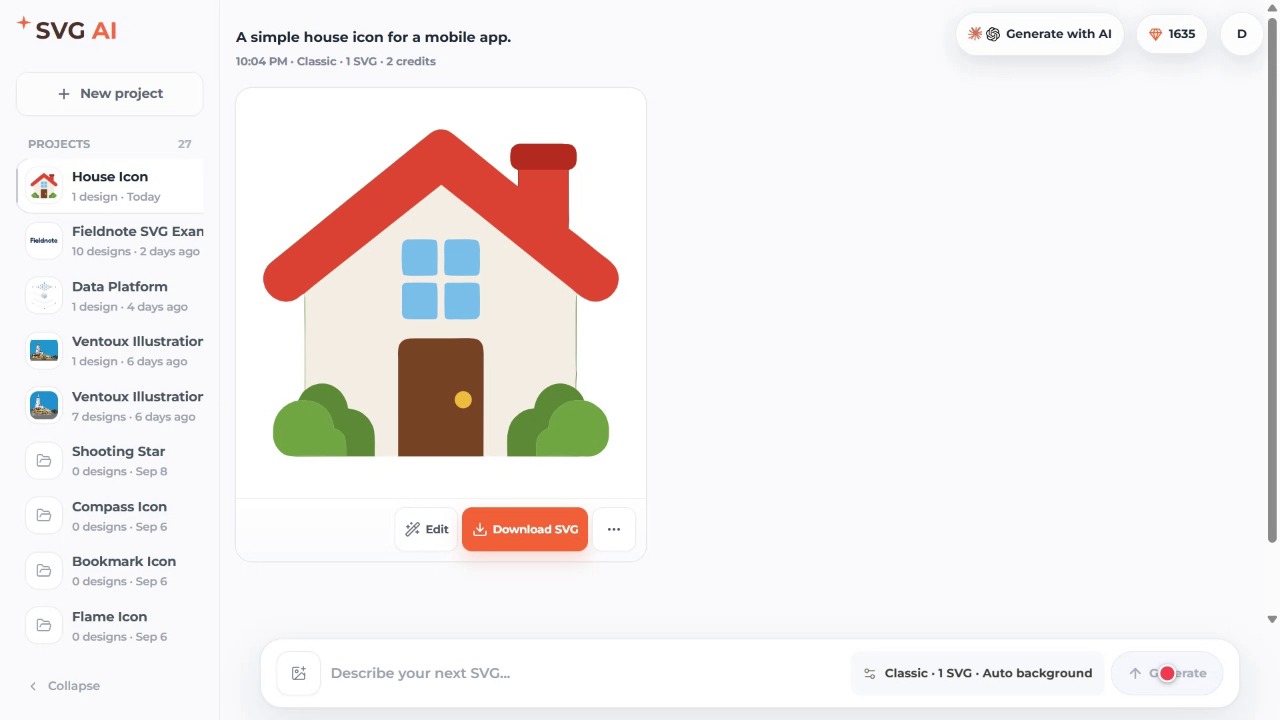
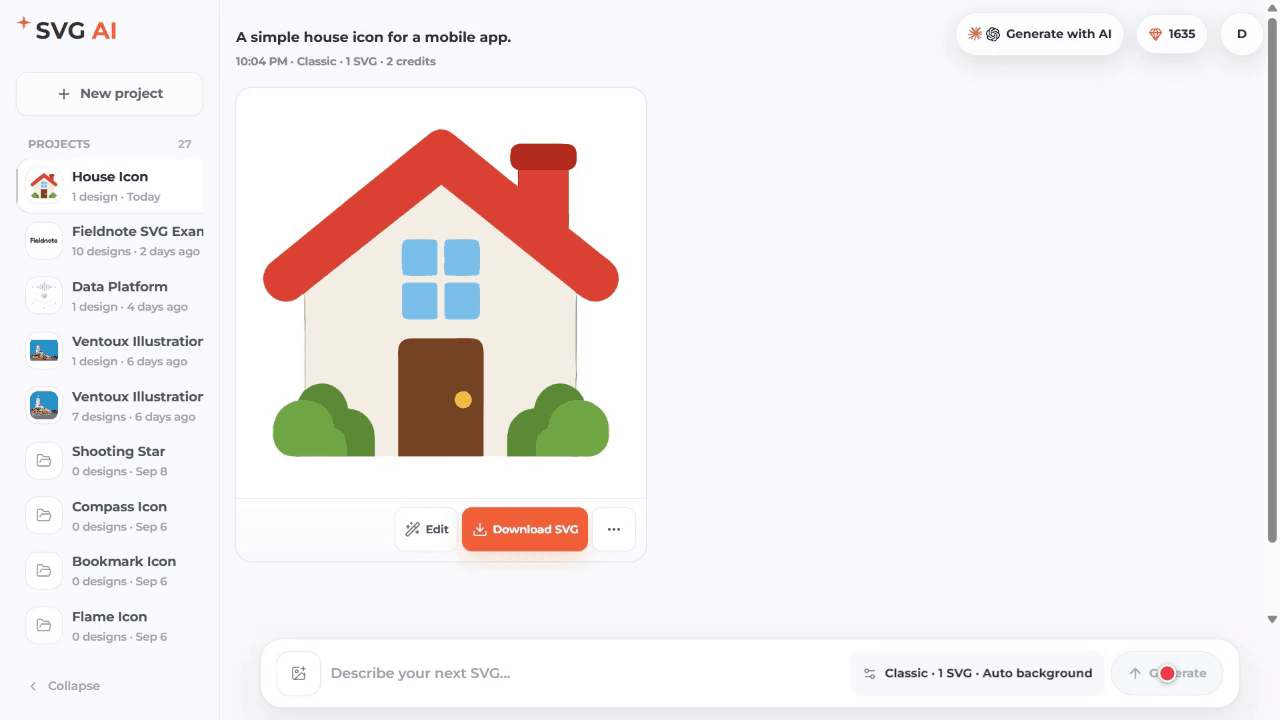
The subject was a simple house icon, generated as an icon for a badge on a fictional home-inspection app. Every dashboard setting stayed the same across all six runs: Classic, one SVG, and the background control left at its default reading of Auto background. Only the prompt text changed.
Each prompt length was run twice, so that the difference between two runs of the same prompt could be seen rather than assumed away.
The three prompts
Shortest — eight words:
A simple house icon for a mobile app.
Middle — thirty-four words, adding a use, a composition and an explicit palette:
A simple flat house icon for a fictional home-inspection app badge.
Square composition with generous padding, rounded line ends, dark navy
#18345F only, no lettering, no filled background, no gradients or shadows.
Transparent background.
Longest — ninety-three words, adding geometry, named parts and a longer list of exclusions:
A simple flat house icon for a fictional home-inspection app badge, used at
48px in a mobile list. Square composition with generous padding, rounded line
ends, a single continuous outline, an even roof pitch, a centered door and one
square window. Use only dark navy #18345F for strokes with a white fill for the
house body, no lettering, no text, no filled background, no gradients, no
shadows, no texture, no mockup, no perspective, no isometric angle. Draw the
chimney centered on the right roof slope and keep the overall silhouette
symmetrical. Transparent background.
What the exported files actually contained
Counted from the downloaded SVG files, not from the preview:
| Run | Prompt words | Export size | Paths | Distinct fill values |
|---|---|---|---|---|
| 1 | 8 | 9,934 characters | 13 | 8 |
| 2 | 8 | 17,754 characters | 29 | 12 |
| 3 | 34 | 6,073 characters | 4 | 1 |
| 4 | 34 | 5,646 characters | 6 | 1 |
| 5 | 93 | 4,613 characters | 9 | 2 |
| 6 | 93 | 5,352 characters | 10 | 2 |
The two runs of the same prompt disagreed
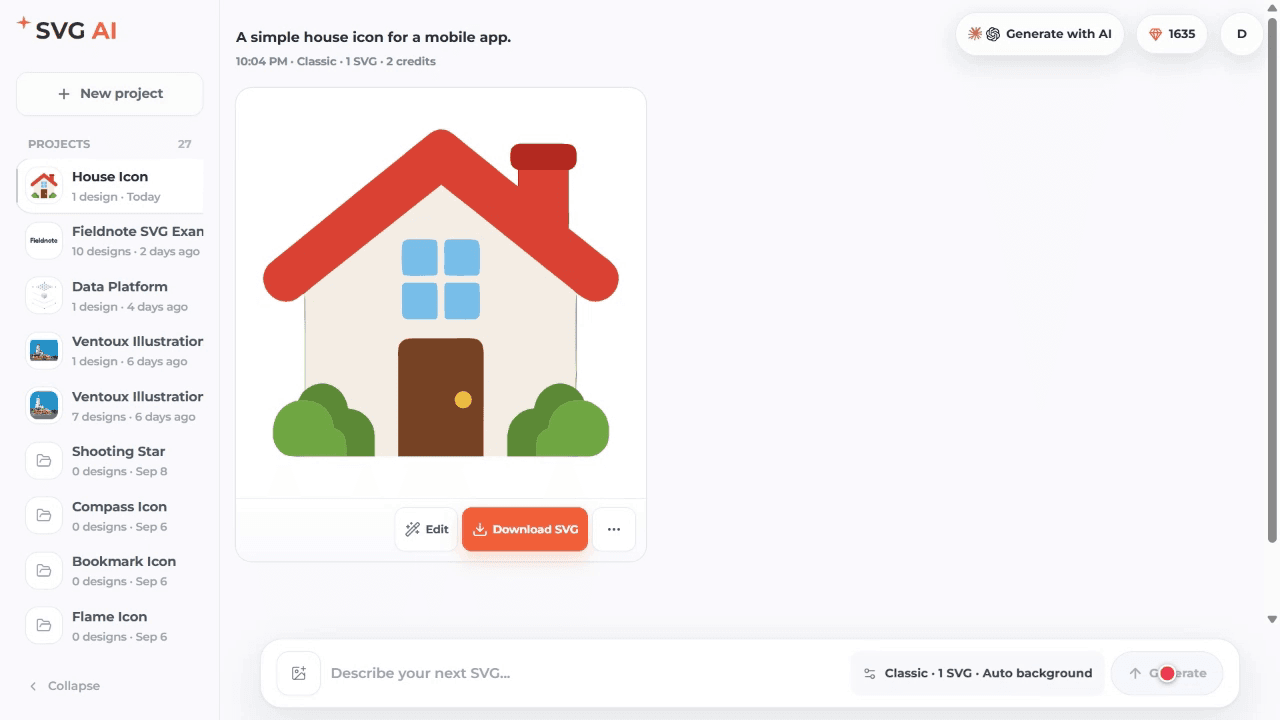
Runs 1 and 2 used an identical eight-word prompt. The first returned 13 paths and eight fill values. The second returned 29 paths and twelve fill values — more than twice the geometry from the same sentence.
This is the single most useful thing to know before writing an SVG prompt, and it is easy to miss if you only generate once. A prompt is not a specification that maps onto one output. It is a direction, and the result has a range. If the first result is close but not right, the prompt is not necessarily the problem; running it again is a real option, and it is cheaper than rewriting.
Where prompt length did pay off
The palette instruction was the one thing that held across both repeats. Naming "dark navy #18345F only" brought the file down to a single fill value in both middle-length runs, from eight and twelve at the shortest length. If a design has to sit next to a brand colour, that is the instruction worth carrying.
Two instructions from the longest prompt also showed up in the export. Both runs produced a house with a door and window openings, and the navy was applied to the outline rather than scattered across the shape.
Where it did not
Path count did not rise with prompt length. The middle prompt produced the fewest paths of all — four and six — fewer than the shortest prompt and fewer than the longest. If you were expecting a longer prompt to yield a more detailed drawing, these six files do not support it.
Two smaller things are worth knowing.
The exact requested colour appeared once in six runs. Run 3 used rgb(24,51,89), which is exactly #18345F. Runs 4, 5 and 6 used rgb(19,53,92), rgb(25,53,96) and rgb(28,55,94) — all close, none exact. Naming a hex makes the palette consistent; it does not guarantee the value lands on the number.
And the longest prompt asked for navy strokes with a white fill. The export contains no stroke attribute at all. It used fills instead. The drawing is close to the description, but the instruction about how the colour should be applied was not followed literally.
One thing the shortest prompt did that nobody asked for
Both short-prompt runs produced a filled background behind the house, even though the prompt never mentioned a background and the background control was left at Auto background. If you need a genuinely transparent export for an icon that will sit on a coloured page, that is worth checking in the file rather than trusting the preview.
Watch the whole test
How to use this
Generate the subject first with a short prompt, and look at the result before adding anything. Then add detail only where you can point at a reason: a palette you have to match, a part that has to exist, a size the icon has to survive. Length itself did nothing measurable in this test.
Run it twice before deciding a prompt failed. The spread between the two identical short-prompt runs was larger than the spread between any two different prompt lengths.
Then open the exported file and check the two things the preview hides: how many values the fill attribute actually uses, and whether a background shape is really there.
Every file from this test is downloadable, so the counts above can be checked rather than taken on trust:
- Shortest prompt, run 1 — 13 paths, 8 fill values
- Middle prompt, run 1 — 4 paths, 1 fill value
- Longest prompt, run 1 — 9 paths, 2 fill values



To run the same test on your own subject, open the AI SVG generator and start with the eight-word version. If you want the background discussion in more depth, how we inspect the SVG files sets out the checks used here. For the wider question of what to put in a prompt and why, the related prompt engineering svg creators guide covers the decisions this test did not measure.
What this test does not say
Six files from one subject cannot tell you that any prompt length is best, and they are not evidence of a general rule about path counts. They also say nothing about other subjects, other model options or other settings — all three prompt lengths were generated with the same settings on a single day.
The one finding worth carrying forward is narrower and more useful: in these six files, a named colour produced a consistent palette, and everything else was a range rather than a number.